
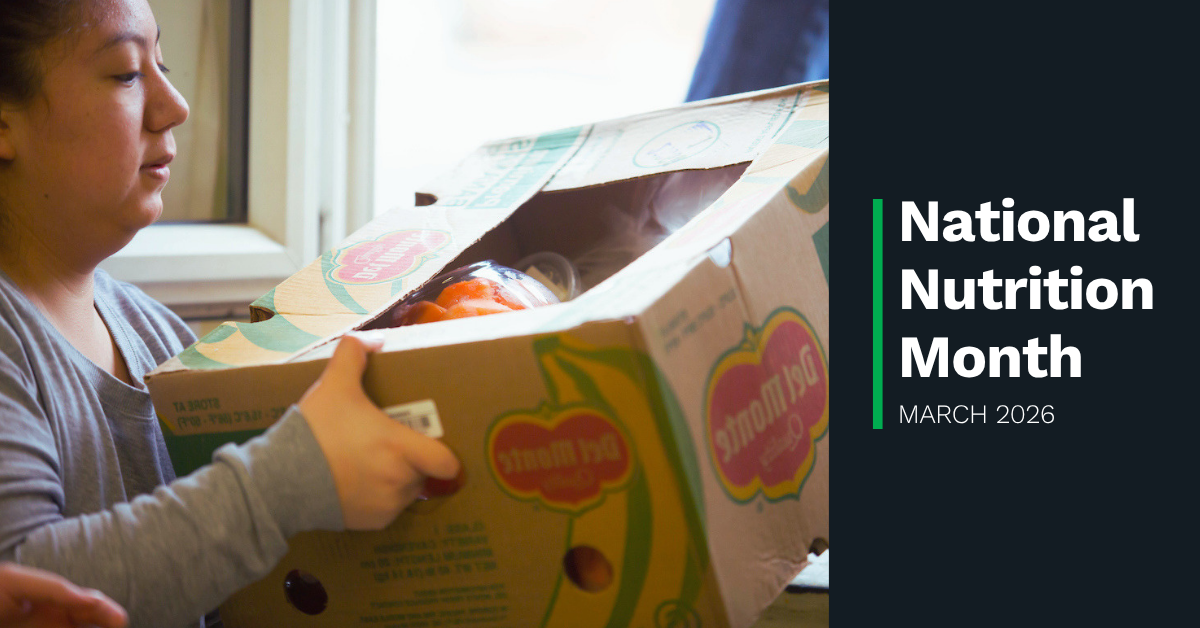
March is National Nutrition Month, and this year’s theme, “Discover the Power of Nutrition,” brings the following question to mind: Who can access this power?
We know that nutritious foods can prevent and treat chronic conditions, like diabetes, and can lower healthcare costs, but access to fresh, healthy food has not been equitably available to all. The common term “food desert” has been corrected to “food apartheid” by food justice activists, like Dara Cooper and BILPOC communities who have been most affected, to more accurately describe the inequitable distribution of food access caused by historical and intentional racist and classist policies. This reality is rooted in a legacy of redlining and disinvestment that shapes where grocery stores are located and the kinds of food options available in stores.
Upcoming federal changes to the Supplemental Nutrition Assistance Program (SNAP) will compound these structural barriers and continue to threaten access to healthy food for many residents and families in the HCF service region.
Today, we also recognize Trans Day of Visibility, and visibility in health data matters, too.
Transgender adults are 2.5 times more likely to experience food insecurity than cisgender adults in America, and more than twice as many report barriers beyond food access, including simply not being able to leave home to buy food. These statistics likely undercount reality, as most hunger research measures food insecurity across the LGBTQIA+ community broadly, but trans-specific experiences are not fully understood and are missing from data used to design food and other health programs. This is where the structural issue lies, because when populations are not counted, they are not resourced.
Hunger is not just a food access or poverty issue—it is the result of cumulative structural factors that were not designed with everyone in mind. An individual’s health outcomes and life expectancy are impacted by factors such as transportation barriers that make a quick grocery run impossible, language barriers that exclude non-English speakers from understanding public benefits, and housing instability that makes cooking healthy foods difficult. This is how the social and structural determinants of health intersect and how their harmful effects build on each other.
But when communities organize to find and implement solutions together, their effects can also build on each other.
Across the HCF region, our grantee partners are doing the work of building a food system that reflects what communities need to thrive—from Life is Work’s Food Pantry filling the gaps from missed SNAP benefits, to the Forty Acres Fresh Market, a part of Austin Coming Together’s Austin Eats Coalition, making fresh produce available in the Austin neighborhood, to Beyond Hunger, who served a record-high amount of community members in 2025 and now plans to expand their space in 2026, to Dion Dawson, Founder & CEO at Dion’s Chicago Dream, sitting on the Federal Advisory Committee for Urban Agriculture and Innovative Production and fighting hunger at the federal level. Healthy Communities Foundation is proud to be part of that ecosystem.
Discovering the power of nutrition means ensuring everyone in our service region can access that power.